Thursday, May 3, 2012

Rpg Final: Ideal Home

        The concept of the ideal home was one of the platforms of our society and the American Dream. But in the beginning a home was a just a shelter from the harsh weather found in nature “Nature was not considered a gentle, inspiring force to be courted…the wall of the house was decidedly a barrier to the outside.”  (Wright, 12) This blockade from the outside world was the ideal home at one time. But from this understanding a home became many interpretations, as seen throughout neighborhoods and cities. There are Mac-Mansions, apartments, condos, or just a simple town home. “A man’s house is his art-at least a house is the nearest to art that most men will ever come.” (Winton, 1) With this the home is specialized and characterized by those who live in it and by those who see it as what it is a work of art.


"Make a Wish Cottage" by Thomas Kinkade
         Thomas Kinkade shows his views of homes, placed in rural secluded areas, surrounded by  surreal aspects of the space around the home. His homes show a Disney-like sense of bliss with warm colors and perfect landscape. In this piece entitled “Make a Wish Cottage”, he shows a rustic old cottage nestled in the woods with flowered bushes and a warm light glow from within. You can almost see the happiness pouring from the home and the comfort found within this ideal home. In this portrayal you are in a safe haven from the outside within a perfect setting.  
"A Hometown Morning" by Thomas Kinkade

“A Hometown Morning” by Thomas Kincaid’s is similar style and feel but this time in a more crowded dimension where the hues and colors are the same warm blissful feeling. The homes still offer this yellow glow but now we see a whole neighborhood with a family walking down the street. Depicted is a lively neighborhood close to a church and even a few pets running through yards with white picket fences. This is the superb suburb where neighbors are friendly and welcoming, church is nearby, and everyone knows everyone type of home. "Concepts of the home as a private refuge, a place of peace and inspiration, became something more that abstract images."(Wright, 107)

"Three Windows" and "House 9" by Charles Ritchie


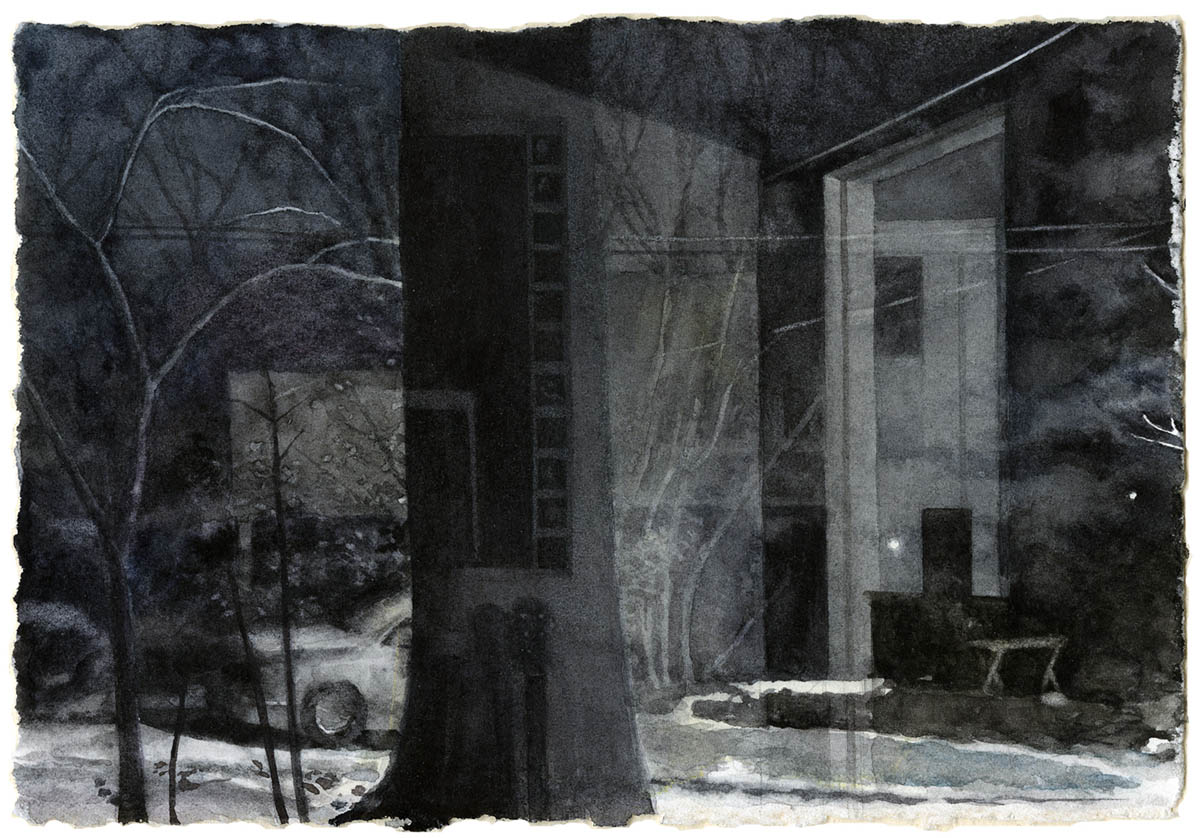
"Snow" by Charles Ritchie
         In contrast, we have Charles Ritchie, who portrays the home and neighborhoods in a night setting, where homes show an almost eerie bit of light that’s not warm or comforting. There is more of a mysterious sense offered in his paintings. Such as this work entitled “Three Windows” and "House 9" the homes are barely illuminated with cold dark tones. The houses don’t give off a haven like feel from the outside but a more cut off from the world shut in neighborhood.
         In "Snow" by Ritchie we see someone looking upon his neighbors from the inside of a home as a barrier from the outside with reflections of what's inside along the window pane. This one lacks any lights on inside homes just light from a street lamp illuminating the few leaf-less trees. Ritchie’s works relate back to the puritan concepts where “Surveillance of one another was necessary.”(Wright, 12) His homes show the outside as dark and ominous almost like a warning to leave your sanctuary.


In Hayden, from Kathleen Ann Mackie in speaking of the ideal home: “home distinguishes “familiarity from strangeness, security from insecurity, certainty from doubt, order from chaos, comfort from adventure, settlement from wandering, here from away.” (Hayden, 145) We see in comparison of Kinkade and Ritchie that ideal homes give security, familiarity, order, comfort, and settlement. We see more comfort from our perspective from Kinkade’s works but Ritchie shows that his views on the home are a more dreary approach to some but to him they are representations of the houses he sees and how he perceives them. His works show more of a fear to the outside and the unknown even within your own neighborhood. Is his home ideal? To some who have a fear of the unknown this is an accurate depiction of their home, secluded, separate, and safe.

Works Cited

Hayden, Dolores. Redesigning the American Dream: The Future of Housing, Work, and Family Life. New York: W.W. Norton, 1984.

Griffith Winton, A. "'A Man's House Is His Art': The Walker Art Center's Idea House Project and the Marketing of Domestic Design 1941-1947." Journal of Design History 17.4 (2004): 377-96.

Wright, Gwendolyn. Building the Dream: A Social History of Housing in America. New York: Pantheon, 1981. 

Digital Media

Final Exam

Kris Karpinia
Professors Chambliss & Simmons
RPG 303: The Art & Diversity of Place
3rd May 2012

Final Exam: The Importance of Consumption in Space & Place of the Home


          With the discovery of electricity and the Industrial Revolution, the United States became fixated on consumption.  All forms of media are utilized not only to broadcast shows or news, but serve as a medium for commercials and advertisements to reach millions of new potential customers. The United States, being a capitalist economy, offers the ‘American Dream’ as a lifestyle one can strives for. “With extensive research about the most prevalent domestic fantasies, builders tried to provide what the majority of surveyed families wanted” (Wright, 1981) The 'dream' can only be obtained through the constant behavior of a consuming. “Herbert Hoover...served as president of Better Homes...designed to boost home ownership and consumption” (Hayden, 1984) This example is how the country adopted consumerism as both a lifestyle and hobby.

          In class we’ve come to adopt “...the single family home was one of the defining symbols of ‘the American way of life” (Rome, 2001). We learned that through social pressures, a dynamic in the household has shifted. “A man’s house is his art - at least a house is the nearest to art that most men will ever come” (Defenbacher, 1947) This new luxury of filling a living space with items to customize it to fit the owners personality and individuality is the foundation of the American Dream. “Since the psychological lack driving consumption cannot be forever satisfied, it guarantees the perpetual repetition of the shopping ritual” (Oswald, 1996). It seems that we've started a cycle that is endless; destined for disaster.


           Rachel Whiteread and Andrea Zittel bring the often unnoticed ‘negative space’ into perspective. Their careful observation of detail is shown through often small visual cues. With the “Consumer culture primarily is a visual culture” (Oswald, 1996) it can be argued these two artists show how unoccupied spaces are enhanced when visually portrayed. Both artists in their artwork add a feeling of place when creating them. This feeling draws in the viewer and connects with each on a personal level.
  
(Rachel Whiteread, House - 1993)

          Her work, Rachel Whiteread, is bringing to life what is often unnoticed space. She looks at the connection of whats visible and invisible. Its as if she created a entire new void; sculptural inversion. Whiteread literally depicts this through filling objects with a substance eventually forming a solid cast. This newly formed void generates a inefficient connotation to the space filled. The art piece above, "House" is a concrete cast of the inside of an entire Victorian terraced house.

(Rachel Whiteread, One Hundred Spaces - 1997)

           Whiteread's connection to consumerism in the home is displayed here in the art piece above, "One Hundred Spaces". These one hundred resin casts of the space beneath chairs shows the diversity and abundance of this void in the household. “She allows spectacle to carry the work rather than creating a piece that uses the space in an interesting way that integrates with and supports the concept and materials she has chosen for the installation.” (Gibson, 2005) The different colors of the casts add a visual cue to show not only the variety, but style of each individual.

(Andrea Zittel, A-Z Homestead Unit From A-Z West - 2004)

           Andrea Zittel is an artist that conveys her minimalist lifestyle into small compact living spaces she calls "Living Units". She drastically reduces the size of a house to a small, compartment-like space in which all the necessities of a house are located, but confined and condensed. Her approach to redefine what is considered a living space is an active approach and solution to the growing consumption problem our country faces today. She takes the themes of compactness, adaptability and transportability and literally conforms a house to fit this mold.

(Andrea Zittel, A-Z Wagon Station - )
          
          This piece by Zittel is showing how her work can reflect a positive and independent attitude towards traveling. Her new project site in the California desert has had a huge impact on the work she has been developing. Her work erases the lines between art and life and allows the user or viewer to become part of a visually appeasing life changing experiment.  Her unique design principles have allowed her to remodel living structures into places of not only art, but functionality and simplicity.


Citations:

Daniel S. Defenbacher, ‘A Man’s House is his Art’, Everyday Art Quarterly, no. 5, 1947
 
Gibson, Todd. "From the Floor." : Spectacle, But Not Much Else, in the Turbine Hall. 27 Dec. 2005. 03 May 2012 <http://fromthefloor.blogspot.com/2005/12/spectacle-but-not-much-else-in-turbine.html>

Griffith Winton, A. "'A Man's House Is His Art': The Walker Art Center's Idea House Project and the Marketing of Domestic Design 1941-1947." Journal of Design History 17.4 (2004): 377-96. Print.

Oswald, Laura. "The Place and Space of Consumption in a Material World." Design Issues 12.1 (1996): 42-62. JSTOR. Web. 3 May 2012. <http://www.jstor.org/stable/1511745?seq=1>.

Rome, Adam Ward. The Bulldozer in the Countryside: Suburban Sprawl and the Rise of American Environmentalism. Cambridge: Cambridge UP, 2001. Print.

Wright, Gwendolyn. Building the Dream: A Social History of Housing in America. New York: Pantheon, 1981. Print.


(A-Z Wagon Station Customized By Chris James)
http://zittel.org/works_horizontal.php?a_id=150&tag=%20shelter

(A-Z Homestead Unit From A-Z West with Raugh Furniture, 2004)
http://zittel.org/works_horizontal.php?a_id=102&tag=shelter

(Untitled (One Hundred Spaces) 1995 Resin (100 units) Dimensions variable)
http://www.saatchi-gallery.co.uk/aipe/rachel_whiteread.htm

(Rachel Whiteread, House, 1993)
http://thegreatexposition.com/?p=1859


Final Exam - The Ideal Home

The perfect union of space and place define the ideal home. But many different definitions of perfect and ideal exist. As we have studied in this class, society has shown us a set of accepted norms related to the home. It is then up to individuals to take those ideas and norms and make them their own. As so rightly said by Daniel S. Defenbacher, “A man’s house is his art – at least a house is the nearest to art that most men will ever come” (Idea House Project, 377). In the case of the artists Andrea Zittel and Thomas Kinkade, the idea of art and the home comes together through all of their pieces. When compared, these artists are different in both the execution and design of their art. But they are similar in that they have adapted society’s ideal home into their own and specific representation of what it should be. 

“The discourse around the modern house is fundamentally linked to the commercialization of domestic life” (Idea House Project, 379). This quote reflects how American housing has attempted to find a one-size fits all model for the perfect home. Artist Andrea Zittel’s work breaks that one-size fits all mold and creates a new image of the functional home and what one truly needs to live. The traditional American home image has been that bigger is better. Zittel’s work shows us that smaller, but more functional units can be better. Seen below are two images of her 1994 living unit. This structure contains the basic necessities needed for the comfort and support of everyday activities. These images of her work illustrate how her structures can be moved around and changed for different uses. 


"AZ 1994 Living Units" 

Seen below is another living structure created by Zittel. “Indy Island is a fully inhabitable experimental living structure that examines the daily needs of contemporary human beings. The island is being occupied over the course of four summers by commissioned ‘residents’ who adapt and modify its structure according to their individual needs, while also serving as ‘hosts’ in order to facilitate public viewing of the work" (Zittel.org). 


"AZ Indy Island"

Andrea Zittel’s work reflects that her ideal home is small in space and can be located in almost any place. Her design choices indicate that she values basic functionality. 


When looking at Thomas Kinkade’s work is it clear that his ideal home is very different than that of Zittel’s. “My mission as an artist is to capture those special moments in life adorned with beauty and light. I work to create images that project a serene simplicity than can appreciated and enjoyed by everyone” (Thomaskinkade.com). 


Thomas Kinkade's "Gingerbread Cottage"

In Kinkake’s piece above we are greeted with the use of warm colors in an inviting space. In another work by Kinkake below, we can again see a similar environment with the same types of colors. His design choices indicate that he wants to portray a desirable home and living environment. His paintings are cottages with lots of natural elements like trees and plants. This gives us the idea that nature and the home is something of high importance to him.


Thomas Kinkade's "Make a Wish Cottage"

“For private space to become a home, it must be joined to a range of semiprivate, semipublic, and public spaces, and linked to appropriate social and economic institutions assuring the continuity of human activity in these spaces” (Hayden, 170). This quote represents what American society has imposed, but Kinkade shows the home in a private setting instead of in a neighborhood or public sphere. Almost every single work of Kinkade's is in a secluded, country like setting with the home as the main focus of the piece. This reflects that Kinkade’s ideal home is fairly large and cozy in space, and filled with nature and the countryside in place. 

Through the work of these two unique artists we have been able to see what each respectively believes is the perfect union of space and place in a home setting. The culturally accepted norms of society will always exist, but each individual has the opportunity to modify those norms to what works for them. 

Works Cited: 

"About Thomas Kinkade." The Thomas Kinkade Company. Web. 01 May 2012.
<http://www.thomaskinkade.com/magi/servlet/com.asucon.ebiz.biography.web.tk.BiographyServlet>.

"Andrea Zittel." Andrea Zittel. Web. 01 May 2012.
<http://zittel.org/works_horizontal.php?a_id=177>.

Griffith Winton, A. “‘A Man's House Is His Art’: The Walker Art Center's Idea House
Project and the Marketing of Domestic Design 1941-1947.” Journal of Design History 17.4 (2004): 377-96. Print. 

Hayden, Dolores. Redesigning the American Dream: The Future of Housing, Work, and
Family Life. New York: W.W. Norton, 1984. Print.

Images Cited: 

www.thomaskinkade.com
www.zittel.org


Final Exam.

The concepts of space and place deal with an individual’s niche in society as related to personal preferences; the Home is the culmination of this compromise.  The ideal home is one where all our needs are met and communal desires are magically in tune with those of the individual. This home caters to the human quest for perfection and appeals to universal aesthetic and moral values regardless of the argument that these are relative. An artist that attempts to cater to the ideal home as a universal standard is the late Thomas Kinkade.  As shown on the painting below, his paintings rely on an over the top source of light to be reminiscent of a higher power.

In this painting, titled “Along the Lighted Path” the sparkling sunshine and presence of nature between individual homes and the church are tranquilizing.  Most of Kinkade’s paintings represent a single home in a beautiful natural setting, yet even the homes in this painting are separated. Kinkade consciously seeks to extend his idea of perfection into every aspect of life. He is able to commercialize it because he caters to the basic puritan value of the home as “a microcosm of God’s exacting structure for the universe.”(Wright, 3) When it comes to the ideals of space, Kinkade’s paintings represent “the desire to give tangible expression to values, in part to celebrate self-confidence and pride, in part from fear to not being able to live up to one’s ideals.” (Wright, 4) His homes emphasize a sort of loneliness. This dark, underlying theme has brought Kinkade criticism, resulting on parodies like the one below:

In Kinkade’s paintings perfection is present, but home exteriors never tell the whole story. If Cthulhu lurks in the ocean depths, then this vision of perfection is nothing but a trap. Why? Because ideals are relative. His homes are reminiscent of an idea and not a true model home as was the case in “The Idea house,” where only Brauer’s design survived since it was a tangible blueprint of a home rather than an idea of perfection. (Winton,19) This theme of a fruitless search for perfection and isolation is also present in Andrea Zittel’s work. Both Kinkade and Zittel’s quests for the ideal home has resulted in art where perfection creates isolation. Nowhere is this better seen than in Zitel’s pocket property.


The Pocket property appeals to the American view that a home belongs to the individual alone. It is also a vehicle and, like Kinkade’s work, it can be mass produced. The difference is that while Kinkade’s ideal is merely visual, Zittel’s ideal is utilitarian.  Like Hayden, Zittel is aware that “the personal happiness of many Americans has been undermined by poorly designed housing.” (Hayden, 57) To her, this is wasteful and inefficient. Zittel’s other works, for example the Living Unit, show a constant quest for utilitarian comfort.


The unit fits anywhere and gives Zittel the commodities of a dream home without engaging in the wild consumption associated with it. Ideal homes are isolated by choice and “because of their isolation from community facilities and from each other, [they] also require numerous purchases of appliances” these appliances increase the use of energy and often are sold as “reinforcement to corporate interests.” (Hayden,65) Through the living units, Zittel sought to solve these problems. In the video below, Zittel tells the story of how she went from living in her parent’s ideal and normal suburban home to creating living units to move towards her utilitarian ideal. “I literally believed that when I made that piece and when I had it completely perfected, that it would solve all my problems.”Once the piece was finished, however, she instead felt “despondent” and “depressed” these feelings gave her the epiphany that “no one really wants perfection” but rather we are obsessed with the idea of perfection and that “what we really want is the hope of some sort of new and improved or better tomorrow.”


Even the way Zittel organizes her home shows a different type of ideal. The levels of organization, meticulousness and need for control and autonomy displays an ideal home that although different from Kinkade’s, creates the same result: isolation. What one can infer from this is that the ideal home, be it alone a lighted path or a pocket property is a direct manifestation of each person’s relative perception of what makes up space and provides a sense of place and personal being. Kinkade’s ideas of beauty inevitably lead to a single home environment, Zittel’s to a complete state of autonomy where others are not needed or wanted but in the end they both take us to the same place.


WORKS CITED

Griffith Winton, A. "'A Man's House Is His Art': The Walker Art Center's Idea House Project andthe   Marketing of Domestic Design 1941-1947." Journal of Design History 17.4 (2004): 377-96. Print

Hayden, Dolores. Redesigning the American Dream: The Future of Housing, Work, and Family Life. New York: W.W. Norton, 1984. Print.

Wright, Gwendolyn. Building the Dream: A Social History of Housing in America. Cambridge, Mass: MIT Press, 1983. Print.

Images Cited

“A Lighted Path.” By Thomas Kinkade http://www.myfreewallpapers.net/artistic/pages/thomas-kinkade-along-the-lighted-path.shtml

“Chtulhu and Thomas Kinkade Lightouse.”  By anonymous.
http://sciencenotes.wordpress.com/2009/04/21/another-kinkade-cthulhu-mashup/

“Pocket Property” By Andrea Zittel
http://www.zittel.org/works_horizontal.php?a_id=95

“1994 Living Unit” By Andrea Zittel
http://zittel.org/works_horizontal.php?a_id=38

Video Cited;

Dowling, Susan., Inc Art 21, PBS Video, and NC Live digital media collection. Art 21: Art     in the Twenty-first Century : Season One; Andrea Zittel speaks. [Alexandria, Va.], 2007.


Nadia's posters and artist's statements.


Consumerism
Consumption is a big part of being American. It has been said the American economy depends on how much the population consumes. Statements such as “consumer confidence” are often heard on the television; we are a consumer culture. Winter Park itself is a consumer culture and it is through the goods and services that Winter Park citizens enjoy that their status and wealth is known. Wether it’s with vintage candy, luxurious car or even a beautiful mall, Winter Park doesn’t keep up with the Joneses, the Joneses keep up with Winter Park but of course, none of this could be done without you.


Women of Winter Park
The city of Women. Winter Park is a city teeming with lovely ladies ready to shop to their heart’s desires. These women have become a staple to the image of Winter Park as it is they who walk out into the streets with their girlfriends and enjoy the sights. However, they are not to be taken lightly. It was the women of winter Park who built the women’s club and it was these women who  made their right to vote known. Outsiders looking in might get a stepford wife feel out of the city of women, but those who know Winter Park well are aware about the tenacity of its women. Housewives, models, shoppers, activists and well rounded social elite.


Race and the home.
This poster represents another facet of Winter Park history. The crinkled paper background aims to give the spectator a nostalgic feel and evoke thoughts of the past. A past in which Winter Park was separated by the train tracks ( into East and West), a past in which Gus Henderson rallied the community to cross the train tracks and votes. Our West Side Story seeks to integrate that unknown stories into Winter Park history. Even if Hannibal Square counted with its own segregated library or even if something as meager as train tracks separated black from white, its inhabitants still dreamt of something as typical as owning a home or educating their children. The poster represents not only the West side’s story. But Winter Park’s West side story which makes up an integral part of a whole.


The Model Home.
For this poster the topic of the model home was taken into a literal context. Just like clothes on a runway model homes are modified and decorated to look their best and appeal to a wide audience. But just like the clothes on a model, once they are out of the runway people might be surprised to find these homes don’t fit them as well as they thought. Just like the clothes we put on our backs, choosing a home is a matter of individuality. For all we know there is no such thing as a model home.

Final Posters with Artist Statements


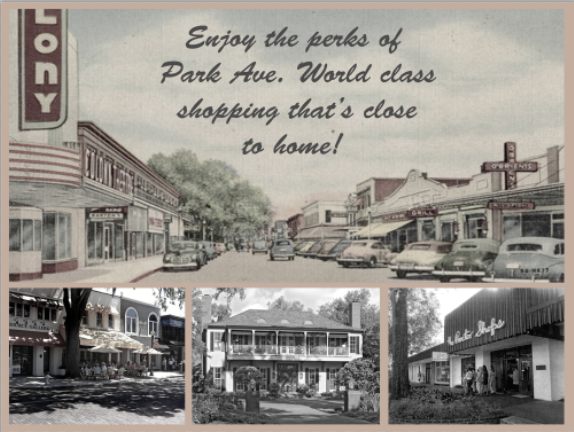
In this poster about consumerism I wanted to illustrate that people choose Winter Park to enjoy its convenience and luxury. I chose images from the past and present to show that Park Avenue exemplifies those qualities. Its various shops cater to different styles and tastes. Because of these world-class shops and restaurants Park Avenue is able to thrive off the community’s need to consume.


This poster conveys the idea that it is the woman keeping the house together. Across the United States a well kept home is very important. Since the housewife is the focus of the home, she is able to please her family and take care of the home inside and out. 


Mary Lee De Pugh was an influential figure in the Hannibal Square community of Winter Park. This poster tries to convey her leadership and importance. She was someone who motivated the community to come together. Through her actions she created the Ideal Women’s Club – an organization that still exists today. 


This poster is about our cultural aspiration for the ideal home. Every home, no matter how big or how small has a floor plan; a conceptual model of how the spaces in the home might be used. I included an image of a floor plan in the background of the poster, but layered additional images depicting two very different lifestyles on top. I wanted to convey the idea that a perfect home is not attainable because the realities of everyday life get in the way. The image of the small, modest home and the messy interior space are equally important because they represent the pride that comes with owning any kind of home, even a small one. It also shows reality of what daily life in the home looks like. 


Wednesday, May 2, 2012

Final Posters and Artist Statements

Consumption and the Home

This poster tries to convey the types of luxuries offered in Winter Park, demonstrating the various ways in which people can invest their money into something considered unique and exclusive, readily encouraging their consumptive trends. Affluent people in Winter Park are defined by what they own; the clothes they wear and the cars they drive. Park Avenue provides the perfect setting, allowing individuals to distinguish themselves from the other well-to-do Winter Park residents. The ultimate American Dream lies within their reach, allowing them to leave their distinct mark in Winter Park. This poster is prompting people to take pride in their willingness to add to the richness of this beautiful town.


Winter Park: A Village Paradise for Every Taste

My poster on gender and the home attracts the attention of both men and women by suggesting the different types of pleasurable and stimulating activities Winter Park has to offer. The poster portrays an ideal village paradise that is characterized by a sophisticated, affluent culture inhabited by dynamic individuals with diverse interests and unique desires. Whether someone’s passion lies in the arts, the outdoors, shopping or fine dining, Winter Park has it all. The high-end boutiques on Park Avenue allow women to purchase unique garments and accessories unattainable elsewhere. Couples can enjoy a glass of wine, a fancy cocktail, and a delicious entrĂ©e at one of the many upscale eateries serving original locally inspired cuisine. The parks, golf courses and scenic lakes surrounding the city offer the perfect outdoor escape. The poster encourages people to pose the question: “What am I waiting for? I want a slice of the good life in Winter Park!”


Winter Park Remembered

In this poster, I chose to tell the unique story of the forgotten community of Hannibal Square, a historic neighborhood on the west side of Winter Park.
The figure at the center of the poster is Gus Henderson (1862-1915), a strong community advocate and newspaper owner, who rallied African-American voters to cast their ballots in favor of Winter Park’s incorporation. Thanks to the efforts of the Hannibal Square Heritage Center, our class learned more about the history of Winter Park’s African American community. The center’s collection includes historic photographs and oral histories designed to educate and preserve the past. When I visited Hannibal Square, I observed a vibrant, lively and bustling community, which has conserved its historic churches, community centers, homes, and parks even as new opportunities for shopping and fine dining have linked the traditional lifestyle in Hannibal Square to Park Avenue’s more affluent profile.


Model Home versus Real Home

This poster exemplifies a simplistic approach to the vision of an ideal home couples should aspire to if they were to become homeowners in Winter Park. The poster reflects a flawless interior design found in many of the dream-like mansions all over residential Winter Park. The images create an atmosphere of harmony and order with soft color schemes allowing the viewer to feel the comfort linked to the idea of a home in Winter Park.


Final Exam: The Ideal Home

Over the course of history, the American people have been faced with constant evolving social norms and pressures swaying them to conform to a set of prescribed standards, particularly in the realm of building and designing the ideal home. The Puritan ideals called for an environment of houses and towns that reflected the divinely ordained structure for creating an idyllic structure for family and social relations (Wright 5). This post examines the complex interplay of the overwhelming commercial, and social influence aimed at guiding people down the right path for building their ideal home and investigates how two different artists, Andrea Zittel and Thomas Kincade address the importance of the ideal home as it relates to the broad concepts of space and place, in light of their unique design qualities and artistic choices.

After the Second World War, the United States government encouraged builders to experiment with mass production techniques, satisfying the huge demand for single-family suburban houses, which had become the most common image of the American way of life. According to Gwendolyn Wright, this has proved the most popular, and fertile, icon of family life and economic success across several centuries of American history (32). In one of his speeches, President Hoover told the people, “to own one’s home is a physical expression of individualism, of enterprise, of independence…it makes for happier married life, better children…(and) it makes for better citizenship” (Rome 24).

"William Levitt, credited as the father of modern American suburbia"

In response to the huge boom of homes, followed by an immense interest in interior designing, and a growing demand for household appliances, an array of model homes emerged, created by various architects attempting to showcase their visions for the ideal American home. In particular, the Walker Art Center exhibited synthesized aspects of modern home design in order to encourage viewers to borrow ideas from a range of examples, instead of “accepting a prepackaged, standardized home design” (Idea House Project 378). These promotional techniques claimed not to be intended to sell specific goods or materials, but rather displayed to encourage a collection of standards considered intrinsically idealistic promoting a collection of ideas on homebuilding and interior design (Idea House Project 392).

The single-family house, the ultimate mark of a freestanding private entity in suburban surroundings reflects longstanding American interest in home ownership. The works of artist Andrea Zittel and Thomas Kincade mirror these ideals with their own interpretations of the ideal home, using specific qualities and unique design choices in their creative works.

Thomas Kincade (1958-2012), the American “Painter of Light”, was America’s most collected living artist, with at least 1 in every 20 homes owning a copy of one of his paintings. He was a talented artist that created pieces reflecting rustic, pastoral and idyllic landscapes with perfect, cozy homes amidst a peaceful, serene and heavenly looking natural surroundings.

"Lamplight Manor by Thomas Kincade"

A key feature in his painting named "Lamplight Manor", is the glowing highlights and saturated pastel colors, that enables Kincade to reveal a highly idealistic home that transports the viewer into a world of beauty, adventure and intrigue. The viewer can easily picture himself living in this tranquil and peaceful painting. The inviting, grand rustic manor house is made accessible by a romantic stone bridge, crossing a slow moving river in a colorful natural spring setting hidden away from civilization.

"Deer Creek Cottage by Thomas Kincade"

In the painting "Deer Creek Cottage" the world is surrounded by a deep wintery natural beauty, a true hideaway that attracts the attention of two fawn standing on the opposite side of a partially frozen stream, gazing into the lights emanating from the cottage windows. A fire is lit inside the snow covered, snug cottage, where a family lives in intimate, warm comfort.

These two paintings reinforce the American ideal of owning a home, preferably in a natural setting with an emphasis on privacy, and located at a certain distance from densely populated urban areas. They promote the ideal of living in American suburbs, considered the safe, clean and healthier alternative to living in cities in 1950 (Hayden 186). Kincade’s images subtly tell viewers that these are the qualities American homeowners should strive to achieve in order to create the same sense of tranquility, peacefulness and richness reflected in these paintings.

Andrea Zittel’s work investigates life in Western societies through her clever installations, which explore the economical, and simplistic approach to domestic living. Her clever designs reduce the amount of items necessary for living in a small cramped apartment setting. Her unique installations minimize the amount of appliances, objects and tools necessary for everyday life and use space efficiently by easily folding up inside themselves. Her work is small and compact, and shows that livable spaces do not always need to be the typical large single-family homes.

"Green Design by Andrea Zittel"

She brings attention to a simpler way of life, living in isolation for long periods of time in a sustainable way far away from the temptation of consumption and the noise of cities.

"A-Z Wagon Station by Andrea Zittel"

These two artists, as different as they may seem are trying to provide examples of ideal homes and modes of living in contemporary America. Zittel’s work shows a modern style, whereas Kincade keeps the style rural and rustic. They both emphasize the importance of finding a natural, peaceful setting, with ample privacy removed far enough from civilization. Zittel promotes a minimalistic approach in terms of material wealth, whereas Kincade seemingly pushes for an excessive amount of materials goods to decorate, and fill up the picture perfect homes. Kincade’s idea of space is far more resource demanding, promoting and propagating suburban sprawl much more than Zittel’s environmentally friendly designs, which taking advantage of every last inch of space available, creating a minimal impact. Zittel’s installations are designed for apartment living, drawing attention to the newest trends and the potential shift towards more practical, and smaller living environments.

Works cited

Hayden, Dolores. Redesigning the American Dream: The Future of Housing, Work, and Family Life. New York: W.W. Norton, 1984. Print.

Griffith Winton, A. "'A Man's House Is His Art': The Walker Art Center's Idea House Project and the Marketing of Domestic Design 1941-1947." Journal of Design History 17.4 (2004): 377-96. Print

Rome, Adam Ward. The Bulldozer in the Countryside: Suburban Sprawl and the Rise of American Environmentalism. Cambridge: Cambridge UP, 2001. Print.

Wright, Gwendolyn. Building the Dream: A Social History of Housing in America. New York: Pantheon, 1981. Print.


Images cited

Time Magazine Cover: “House Builder Levitt”
http://www.time.com/time/covers/0,16641,19500703,00.html

“Transforming Furniture into Green Design”. Photograph: http://inhabitat.com/andrea-zittel/

“A-Z Wagon Station” by Andrea Zittel: http://www.friezeartfair.com/yearbook/artist/100050010/

“Lamplight Manor” by Thomas Kincade
“Deer Creek Cottage” by Thomas Kincade http://www.thomaskinkade.com/magi/servlet/com.asucon.ebiz.home.web.tk.HomeServlet